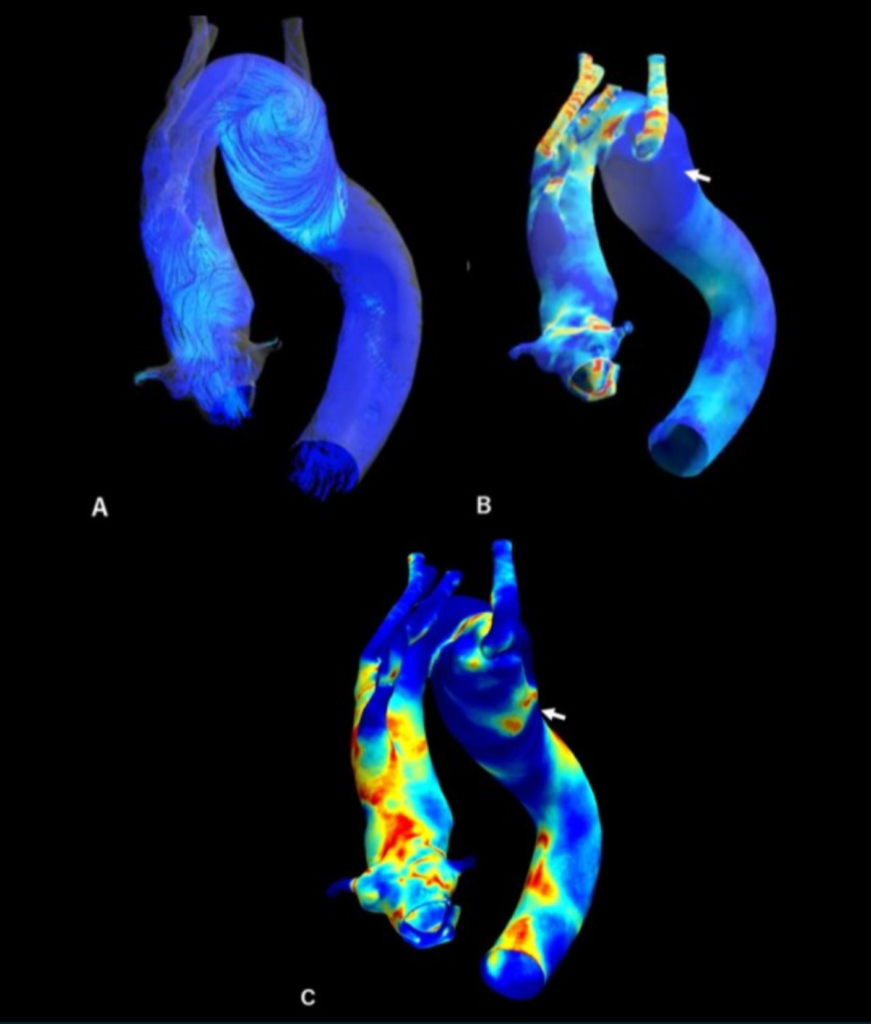
Adverse Hemodynamics in Kommerell’s Diverticulum: A Comparative Case Report Linking Oscillatory Shear Index to Aortic Dissection
This study highlights the importance of hemodynamic assessment in patients with Kommerell's diverticulum, demonstrating how blood flow analysis can provide insights beyond anatomical measurements alone.
Using 4D Flow MRI and Computational Fluid Dynamics (CFD), the authors identified a high-risk flow phenotype characterized by:
🔄 Intra-diverticular vortex formation
📉 Low Wall Shear Stress (WSS)
📈 Elevated Oscillatory Shear Index (OSI)
These findings suggest that OSI may serve as a valuable marker for identifying regions vulnerable to intimal injury and potential aortic dissection, offering a new perspective for risk stratification and clinical decision-making.
As cardiovascular medicine moves toward functional and patient-specific assessment, advanced blood flow analysis continues to reveal insights that anatomy alone cannot provide.
Reference
Kenji Sakakibara, Hiroyuki Nakajima, Yukiyo Yoshida, Yudai Hagihara, Chie Nakamura, Soshi Yamamoto, Daichi Shikata, Yuki Takesue, Satoru Shiraiwa, Yoshihiro Honda, Shigeaki Kaga, Masahiro Hamasaki, Hisashi Johno, Yu Sasaki, and Hiroaki Watanabe, "Adverse Hemodynamics in Kommerell’s Diverticulum: A Comparative Case Report Linking Oscillatory Shear Index to Aortic Dissection", Clinical Case Reports, Volume14, Issue4 (2026) 10.1002/ccr3.72509.
Go To the Journal Page